Grip Strength and Longevity: The One Thing That Reveals How Well You’re Aging (and It’s Not Lifting Weights)
If you’ve ever wrestled with a jar of peanut butter and lost, keep reading. That little moment of frustration in the kitchen might be telling you something much bigger.
Researchers now believe grip strength and longevity are so closely linked that your grip may be one of the best predictors of how well you’ll age. Better than your weight, and honestly, even better than how much you can bench press.
As a trainer in my 60s, I love this news. Because you don’t need to be an athlete to have a great grip. Grip strength is about opening jars, carrying groceries in one trip, holding the railing on an icy Minneapolis sidewalk, and picking up a grandchild without a second thought. Real life stuff.
So let’s talk about what the research actually says, how to test your own grip in under a minute, and the simple ways to build it starting today.
What the Research Says About Grip Strength and Longevity
And no, this isn’t one small study making headlines. Researchers have been landing on the same finding for over a decade.
A landmark study published in The Lancet followed nearly 140,000 adults ages 35 to 70 across 17 countries. The finding? For every 5 kilogram (about 11 pound) decrease in grip strength, the risk of dying during the four-year follow-up went up 16%. The researchers concluded that measuring grip strength is a simple, inexpensive way to assess risk for all-cause death and cardiovascular disease.
Read this twice: a 16% higher risk of death, tied to something you can measure at home with a $25 gadget.
And a 2019 review in Clinical Interventions in Aging, which looked at decades of research, went so far as to call grip strength an “indispensable biomarker” for older adults.
Doctors love this test because it’s simple. No treadmill stress test, no jumping, no athleticism required. Just squeeze.
Why Your Grip Is a Window Into Your Whole Body
Here’s the part I really want you to understand: it’s not the grip itself that keeps you alive. Nobody ever added ten years to her life by squeezing a stress ball on the couch.
Your grip is a proxy. When your hands and forearms are strong, it almost always means the rest of you is strong too. When grip starts slipping (struggling with jar lids and bottle caps that used to be easy), it can be an early sign that muscle everywhere is quietly declining. And we lose muscle naturally as we age, roughly 3 to 8% per decade starting in our 30s if we don’t fight back.
That’s why the answer to a weakening grip is NOT a hand exercise program but a whole-body strength program. The women I train who lift weights twice a week? Their grip takes care of itself.
One caveat: a weak or painful grip can also come from arthritis or an old injury, so if squeezing hurts, get it checked out before you start training.
The 1-Minute Test You Can Do Today
Want to know where you stand? Try a dead hang.
Grab a pull-up bar (a doorway bar works great), grip it with both hands, and let your feet come off the ground. Then just hang there. No pulling up required!
Here’s what to aim for:
Under 20 seconds: your grip needs work, and I’d bet your overall strength does too. No shame. Start where you are.
30 seconds: a solid baseline for women over 40.
60 seconds: excellent. A full minute of hanging is a fantastic marker of grip strength, shoulder health, and core strength all at once.
The best part? The dead hang is both the test and the exercise. Hanging a few times a week decompresses your spine, opens up tight shoulders, and builds grip fast.
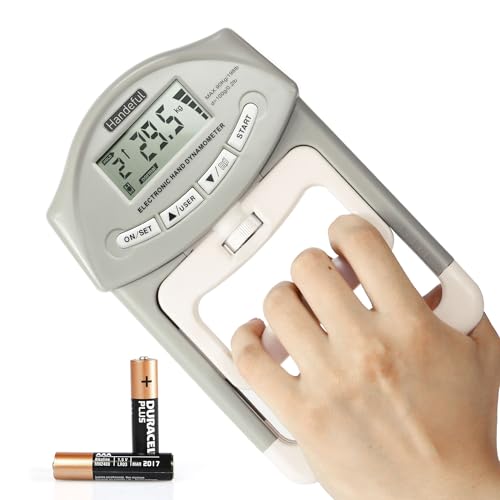
If you want an actual number to track, a hand dynamometer is the same tool used in the research studies. You squeeze it, it gives you a reading in kilograms, and you can watch your number climb over time. I’m a data girl (my Oura Ring can confirm), so I love a measurable win.
Grip Strength Tester, Hand Grip Dynamometer
$25.99
6 Ways to Build Your Grip (and Your Whole Body)
You don’t need a fancy program. You need a few moves done consistently. Here are my favorites:
Farmer’s carry. Pick up a heavy dumbbell or kettlebell in each hand, stand tall, and walk 30 to 60 seconds. This is my number one. It trains grip, core, posture, and bone density in one move, and it’s exactly what carrying groceries asks of your body.
Dead hangs. Covered above! Start with 10 to 20 seconds, build to a minute. Keep your shoulders pulled down away from your ears.
Suitcase carry. A farmer’s carry with only one weight. Your core has to fight the urge to lean, so you get grip work and waist work together.
Towel wring-outs. Soak a bath towel, then wring it out hard in both directions until your forearms burn. It’s old-school, and it works.
Rows and deadlifts. Any pulling exercise where your hands hold the weight (dumbbell rows, deadlifts, lat pulldowns) builds grip automatically. Skip the lifting straps and let your hands do the work.
Carry your own groceries. Seriously! Skip the cart when you can, carry the basket, take the heavy bag in one trip. Daily life is a grip workout if you let it be.
Aim for grip work two or three times a week, tucked into the strength training you’re already doing. And if you’re not strength training yet, this is your sign. Strength training is healthcare, and after 40 it’s non-negotiable.
Use my favorite strength training moves for women over 50 to get started!
A Few Inexpensive Tools That Make It Easy
You truly don’t need equipment for most of this, but a few small things make grip training easier to stick with:
Doorway pull-up bar: for dead hangs at home. Mine lives in a doorframe, and I hang while the coffee brews.
Hand dynamometer: around $25, and it turns your grip into a number you can track like your steps.
Hand grippers: great for car rides and TV time. Not a replacement for real training, but a nice extra.
A pair of heavy dumbbells or a kettlebell: for carries. If you only buy one thing on this list, buy this.
Here’s What I Want You to Remember
Grip strength isn’t a crystal ball, and rebuilding your grip alone won’t magically add years to your life. But it’s one of the clearest, cheapest report cards we have on how our bodies are aging. And unlike your age, it’s something you can actually change.
Cardio is to live longer, strength training is to live stronger, and mobility training is to live pain-free. Your grip gets built right in the middle of all that.
At 60, my goal isn’t a perfect dead hang time. My goal is swinging across the monkey bars with my granddaughter when she asks Coco to play, and opening every jar in my kitchen without hunting down my husband. That’s what grip strength and longevity really look like in everyday life.
Moral of the story? Pick up something heavy this week and carry it across the room. Your grip, and everything attached to it, will get stronger.
PS. Test your dead hang today and write down your time. Retest in 30 days. I’d love to hear how much you improve, so drop a 💪 in the comments and tell me your number!