3D Printing Projects That Restore the Environment
Around the world, designers, engineers, researchers and artists are turning to 3D printing as a powerful tool for environmental restoration and regenerative manufacturing. Once viewed primarily as a prototyping technology, additive manufacturing now enables solutions that support biodiversity, rebuild fragile ecosystems and strengthen conservation efforts in deserts, forests, rivers and coral reefs. From prosthetic tree cavities to biodegradable shelters for young plants, these projects show how digital design and locally adapted fabrication can address ecological challenges with precision and long-term thinking. The examples below highlight practical, nature-based uses of 3D printing in restoration and habitat recovery.
Prosthetic tree cavities in Australia
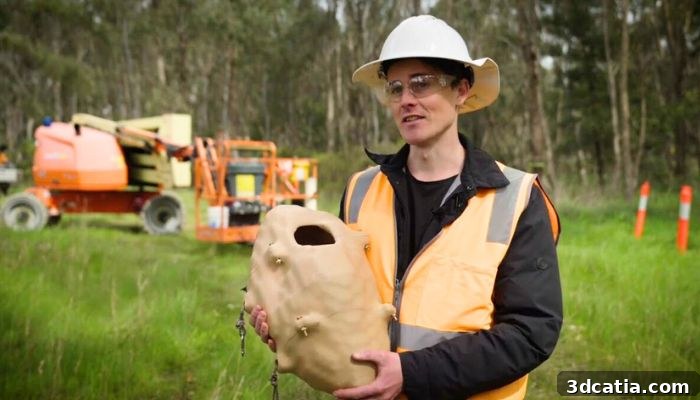
McConnell Dowell, in partnership with Inland Rail and researchers at the University of Melbourne, developed and installed 18 prosthetic tree cavities to support threatened bird and mammal species in central Victoria. Modeled from laser scans of natural hollows and produced with advanced digital modelling and innovative materials such as 3D-printed wood and mycelium-based composites, these cavities offer a more biologically appropriate and sustainable alternative to conventional nest boxes. As the first project of its kind globally, the initiative demonstrates how modern manufacturing technologies can be integrated into large infrastructure programs to improve biodiversity outcomes. Early monitoring already provides valuable data about species usage and behavior, informing scalable habitat restoration strategies.
Photo credit: McConnell Dowell
Nereid: a marine habitat prototype printed in 3D
At the World Design Congress in London, Zaha Hadid Architects and D-Shape presented Nereid, a digitally designed marine habitat intended to revitalize coastal ecosystems, notably in areas like North Lantau Marine Park near Hong Kong. The project aims to promote growth of phytoplankton and filter-feeding shellfish—the foundation of healthy marine food webs—to counter biodiversity loss driven by climate change, urbanization and pollution. Using low-emission concrete 3D printing and neutral-pH materials, Nereid reproduces the texture and porosity of natural reef structures, creating biomimetic modules that can be installed in varied coastal environments to support ecological recovery and coastal resilience.
Photo credit: ZHA
TreeSoil: 3D-printed shelters for young trees
TreeSoil addresses the vulnerability of recently planted trees, especially in arid and exposed regions where wind, sun and harsh conditions threaten early growth. Developed at the Technion Material Topology Research Lab in Israel, TreeSoil uses robotic 3D printing to fabricate protective shelters from a mix of clay, sand, organic fibers and cellulose. The printed shells are air-dried and assembled around saplings without adhesives, making them fully biodegradable and soil-resorbable. As trees mature, the shelter naturally degrades and contributes nutrients back into the soil—an elegant example of regenerative design paired with additive manufacturing.
Photo credit: Edo Asoulin
Coral reef tiles
Archireef has been restoring damaged coral reefs using 3D-printed terracotta tiles designed to mimic the natural surfaces where corals settle. These tiles feature smooth, curved forms that give vulnerable coral fragments stable attachment points during their earliest, most delicate weeks. In a project in Hong Kong, hundreds of tiles were placed over an eroded seafloor area to create new anchoring points for corals, fish and other marine life. Lightweight and modular, the tiles can be carried and positioned by divers without heavy machinery, minimizing disturbance to sensitive sites. The approach acknowledges that reef recovery is gradual: rather than attempting to speed natural processes unnaturally, these structures provide a stable foundation for ecosystems to rebuild incrementally.
Entomological Utopias: ceramic shelters for insects and small wildlife
Artist Raphaël Emine collaborated with 3D printing firm WASP to design ceramic habitats for insects and small forest fauna, drawing inspiration from natural patterns such as honeycomb cells, spider webs, worm galleries, plant fractals and geodesic mineral formations. The resulting installations—printed on large-scale clay printers like the WASP 40100 LDM and Delta WASP 2040 Clay—feature tunnels, galleries, balconies and corridors that create dynamic microhabitats. Two such installations were created in 2023 and 2024 and installed at Parc de la Maison Blanche in Marseille, offering a blend of art, architecture and ecological function that enriches local biodiversity.
Photo credit: Raphaël Emine
Desert Ark project in China
Desert Ark, a project by Chinese studio designRESERVE, shows how 3D printing can support restoration work in extreme environments. Located in the Tengger Desert (Inner Mongolia), the project comprises nine 3D-printed modules made from a cement-and-sand mix, designed to house volunteers engaged in reforestation. Fabricated offsite for quality control, the modules are transported to the desert and assembled in just two days without deep excavation. Each module serves a specific function—sleeping, cooking, dining, sanitation—and the wavy, insulated walls are engineered to withstand temperatures from severe cold to extreme heat. Arranged around a central terrace with a retractable canopy and solar panels, Desert Ark provides practical, low-impact accommodation that enables conservation teams to work in remote locations.
Photo credit: Huaer Lin, Yong Hu, ATDEF team
3D-printed coral skeletons in calcium carbonate
Researchers at KAUST developed a 3D printing method intended to speed coral reef restoration by producing eco-friendly supports made of calcium carbonate that mimic natural coral skeletons. Using scanned coral geometries and a customized calcium carbonate resin, the CoraPrint process creates non-toxic, highly detailed substrates that can be seeded with living coral microfragments. Promising aquarium trials suggest this technique could be a significant step toward more sustainable reef restoration. The team plans larger field trials to assess how these printed structures perform in real ocean conditions and whether they help increase reef resilience over time.
Photo credit: KAUST / Anastasia Serin
Ceramic river habitats
C-ecology, a student project from Tunghai University, proposes using 3D-printed ceramic modules to create reef-like structures for urban rivers. Designed to fit waterways of different sizes, these modules offer habitats for aquatic species while improving flow dynamics and ecological balance. Recognized by the Green Concept Awards, the team is planning real-world pilot implementations to demonstrate how additive manufacturing can deliver nature-based urban water solutions. If successful, the system could become a scalable model for cities seeking to restore biodiversity in heavily modified or polluted waterways.
Photo credit: Tunghai University / Green Project Award
These examples illustrate the growing role of 3D printing and additive manufacturing in ecological restoration, from terrestrial and desert environments to rivers and coral reefs. Each project demonstrates a different way that digital fabrication can support habitat recovery, biodiversity conservation and low-impact infrastructure for restoration teams. Which of these innovations do you find most compelling for environmental restoration? Share your thoughts and join the conversation—follow the topic on social media platforms such as Facebook or LinkedIn to stay updated.
The post 3D Printing Projects That Restore the Environment first appeared on 3dcatia.