BMW Promotes Recycling with 3D Printing
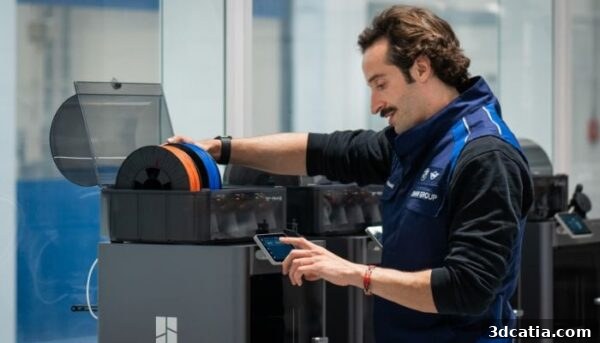
The BMW Group has reached a new milestone in circular economy practices. At its additive manufacturing campus in Oberschleißheim, southern Germany, the company now recycles waste powder and end-of-life 3D-printed components to create fresh 3D printing materials. This process promotes sustainable use of plastics and enables large-scale, innovative recycling—a priority for BMW. Where used powder was once discarded, it is now converted into new filament that is wound on spools and fed into FDM 3D printers. The campus also produces recycled granules for FGF (Fused Granulate Fabrication), a technique BMW uses to manufacture large quantities of parts efficiently.
From pilot project to mass production
Led by Paul Victor Osswald, project manager since 2018, the recycling initiative has evolved from a pilot phase to full industrial scale. The programme began with the “bottleUP” project, which recycled PET bottles to produce prototypes using recycled in-house materials in 2021. Today, the site recycles up to 12 tonnes of waste powder annually, bringing cost savings, improved material quality and better ergonomics across the facility. As Osswald explains: “It is an exciting challenge to continually develop and test new processes. Using waste powder and end-of-life 3D-printed components is a key element of a functioning and efficient circular economy.”
The recycled materials can be used on FDM machines
The Oberschleißheim additive manufacturing campus functions as a centre of know-how and technology transfer. It supplies not only recycled materials but also optimized print parameters, training programs and comprehensive technical support for BMW production sites worldwide. The campus collaborates closely with manufacturing plants to validate suitable 3D printers and to develop print profiles. This integrated support lets factories adopt recycled materials quickly and safely, with a full package of documentation, process settings and training that reduces deployment risk.
Versatile recycling applications across BMW
Recycled 3D-printed components are already in use across several BMW sites. In Munich, a recycled 3D-printed part is used for precise steering rod positioning. In Berlin, special printed fixtures assist with decorative finishing on motorcycles. In Dingolfing, printed magnetic screw holders prevent small parts from being lost during assembly. These practical applications demonstrate both environmental and operational benefits: reduced material consumption, lower waste volumes, faster on-site innovation and shorter iteration cycles for tooling and fixtures. Producing parts locally with recycled feedstock allows teams to adapt quickly to assembly-line needs and to resolve issues before they cause production interruptions.
Example of a tooling part 3D-printed by the automaker
Transitioning from virgin powder to recycled printing material showcases BMW’s technological leadership and its active role in advancing a circular economy. The initiative follows a clear, systematic pathway—from initial concept to pilot material and finally to standardized production material—demonstrating how innovation can scale responsibly. The additive manufacturing campus proves to be a hub of innovation, driving ecological efficiency, economic flexibility and widespread implementation of recycled materials across the company’s supply chain.
The benefits are tangible: reduced raw material dependency, lower disposal costs, and a smaller environmental footprint for production tooling and fixtures. Equally important is the cultural shift inside the company—design and production teams are now encouraged to consider recyclability and reuse early in the development cycle. By closing the loop on polymer feedstock and validating recycled materials in real production environments, BMW sets an example for other manufacturers exploring sustainable 3D printing workflows.
What do you think of BMW Group’s recycling initiative? Could this approach influence the broader automotive industry and accelerate the adoption of circular manufacturing practices? If you follow developments in 3D printing for automotive and transportation, the Oberschleißheim campus is a noteworthy example of how manufacturing, materials science and sustainability can come together to deliver pragmatic, scalable solutions.
*Photo credits: BMW Group
The post BMW Promotes Recycling with 3D Printing first appeared on 3dcatia.