Multi-Material 3D Metal Printing: Lightweight, Durable Auto Parts
Lightweighting—the idea that lighter vehicles can improve fuel efficiency, extend electric vehicle range, and enhance acceleration, braking, and handling—is one of the major trends shaping modern automotive design. A persistent challenge, however, is combining different materials to capitalize on their complementary properties, such as the strength of steel with the low density of aluminum. Researchers at the Materials Research Institute and the New Industry Creation Hatchery Center of Tohoku University report an important advance: a new multi-material metal 3D printing technique capable of producing lightweight, durable automotive components.
Additive manufacturing has become widely adopted in the automotive sector because of its precision and ability to create complex, customized geometries. In their announcement, the Tohoku team emphasizes how 3D printing enables unique forms and tailored components. Yet single-material printing often forces trade-offs: one metal may offer strength while another provides weight savings. That is why multi-material 3D printing—printing different metals together within a single part—has attracted growing attention as a way to deliver hybrid performance. Multi-material approaches, however, bring their own technical hurdles, notably at the interfaces between dissimilar metals.
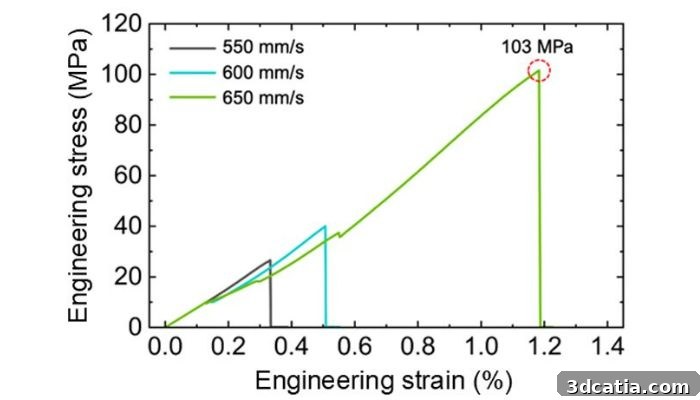
Interfacial strength of steel–aluminum multi-materials melted using laser fusion at different scan speeds (photo credit: Kenta Yamanaka et al.)
“Multi-material printing is a hot topic in additive manufacturing because of the flexibility the process offers,” explains Associate Professor Kenta Yamanaka. “A major practical challenge, however, is that some metal combinations—steel and aluminum, for example—tend to form brittle intermetallic compounds at their interfaces. That can make a component lighter but also more fragile.”
Focusing on laser powder bed fusion (LPBF), a leading additive process in automotive manufacturing, the researchers aimed to fuse steel and aluminum in a way that keeps the assembly both light and structurally sound. The team found that increasing the laser scan speed during LPBF dramatically reduced the formation of brittle intermetallic compounds—specifically phases such as Al5Fe2 and Al13Fe4 that are known to compromise toughness.
Bonding results for steel–aluminum alloys processed by LPBF at various laser scan speeds (photo credit: Kenta Yamanaka et al.)
The researchers attribute this improvement to a phenomenon called non-equilibrium solidification. Faster scan speeds shorten the time metal remains molten, which suppresses segregation and the formation of continuous brittle phases at the interface. This rapid solidification can limit the partitioning processes that typically produce weak intermetallic layers, enabling much stronger metallurgical bonding between steel and aluminum regions. As team member Seungkyun Yim put it, “You cannot simply stick two different metals together and expect a flawless bond. It was necessary to understand the in-situ alloying mechanisms occurring during printing.”
The practical outcome of this research is a working prototype: what the team describes as the first large-scale, multi-material automotive component produced by this method—a customized suspension tower that integrates steel and aluminum in a single printed part. The research group plans to extend their approach to other metal combinations and more complex geometries to broaden the range of automotive and industrial applications. The full study and experimental details are available from the authors for readers interested in the technical data and process parameters.
This work highlights several important trends for the automotive industry: the drive to reduce mass without sacrificing safety and performance, the maturation of multi-material additive manufacturing as a practical tool, and the importance of process control—such as laser parameters—in tailoring microstructure and interfacial properties. By carefully controlling LPBF conditions, manufacturers can mitigate the formation of deleterious phases and produce hybrid structures that combine the best attributes of each metal.
What do you think about the potential of multi-material 3D printing in automotive applications? The research suggests a promising path toward lighter, more efficient components, but wider industrial adoption will depend on reproducibility, cost, and qualification for safety-critical parts. The Tohoku team’s findings add valuable insight into how process engineering can overcome longstanding metallurgical barriers and help realize the full promise of functionally graded and hybrid metal parts.
Photo credits for header image: Kenta Yamanaka et al.
The post Multi-Material 3D Metal Printing: Lightweight, Durable Auto Parts first appeared on 3dcatia.