US Researchers Develop 3D-Printed Blood Capillary Networks
Researchers at the University of Notre Dame have succeeded in 3D-printing networks of blood capillaries using an unusual hybrid technique. Before describing their method, it is important to recall the medical stakes. In the United States alone, more than 100,000 people are waiting for transplants while donor organs remain scarce. 3D-printing organs from a patient’s own cells could help address this shortage and, critically, reduce the risk of immune rejection.
That is why teams worldwide have been pursuing 3D bioprinting for decades. One of the major hurdles is reproducing the scale and complexity of the human vascular system—especially the microvasculature made up of capillaries. Capillary networks form a dense mesh of the body’s smallest blood vessels; these microscopic conduits deliver oxygen and nutrients to cells and remove waste, making them essential for any viable bioprinted tissue model.
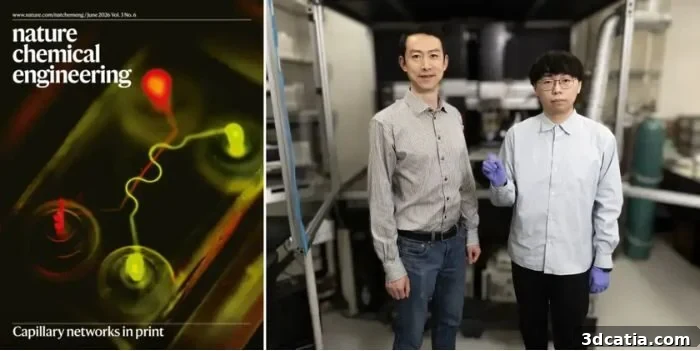
Left: capillaries visualized by fluorescence imaging, featured on the cover of Nature Chemical Engineering. Right: Yanliang Zhang and Yuxuan Liao, the latter a doctoral student and lead author of the study. (Photo: Wes Evard / Notre Dame College of Engineering)
“Printing blood vessels that accurately mimic natural living systems is extremely difficult because their sizes vary so widely,” explains Yanliang Zhang, Advanced Materials and Manufacturing Collegiate Professor in the Department of Aerospace and Mechanical Engineering. “Reproducing the smallest vessels without sacrificing scale-up capability or structural integrity remains one of the greatest challenges for advanced bioprinting technologies.”
Combining two 3D printing methods
To print vascular networks that include capillaries smaller than 10 micrometers in diameter—thinner than the finest human hair—the team combined two complementary printing techniques, assigning each to a specific function. The tissue-like scaffold, or matrix, is first printed by extrusion: biomaterials are deposited under pressure, layer by layer, to form a soft, gel-like structure that mimics tissue properties. Once a portion of the matrix is printed, fine gelatin filaments are deposited inside it using Aerosol Jet Printing (AJP). These gelatin filaments act as sacrificial templates and are later removed to leave hollow channels inside the matrix.
AJP employs an aerodynamic sheath flow that focuses the deposited material, enabling precise control over filament dimensions. This approach yields a wide range of diameters: gelatin filaments can range from several hundred micrometers down to just a few micrometers, reproducing the hierarchical architecture of natural blood vessels.
“We have taken a major step forward in bioprinting,” Zhang adds. “Reaching capillary-scale resolution in bioprinting is a key advance toward creating fully functional tissues and whole organs.”
Machine learning to optimize printing parameters
The team also incorporated machine learning to autonomously optimize printing parameters for each desired vascular configuration. Their system refines ink flow and sheath gas flow, then identifies the optimal combination of settings to achieve a target channel size. Automating this optimization accelerates development and reduces the need for laborious trial-and-error tuning.
“Machine learning is a powerful tool that helps us find optimal parameters much faster than traditional trial-and-error methods,” Zhang emphasizes. “Integrating autonomous optimization greatly improved process efficiency and helped us achieve the channel quality and precision we required.”
By combining this hybrid printing approach with machine learning, the researchers produced hierarchical vascular networks in one, two, and three dimensions. Some channels were then seeded with endothelial cells, which form the endothelium—a single-cell-thick lining found inside all blood vessels, heart chambers, and lymphatic vessels. The seeded endothelial cells formed monolayers similar to those observed in living human tissues.
“We are pleased to see that living cells adhere quickly to the inner walls of the channels and spread out, ultimately reproducing the barrier function of real human capillaries,” Zhang reports. “This is a significant achievement, demonstrating that our hybrid-printed networks can host living tissue structures without leaking.”
The tissue-mimicking matrix is printed by extrusion (left), while the sacrificial gelatin material is deposited by Aerosol Jet Printing (right). After printing, the construct is immersed in warm water so the gelatin liquefies and is removed, leaving precise channels inside the matrix (far right). (Image credits: Yuxuan Liao et al.)
Potential applications of 3D-printed capillary networks
Integrated into biomimetic tissue models, these vascular structures could support regenerative medicine, organ engineering, and organ-on-a-chip platforms used to assess drug safety and efficacy. Building such models from a patient’s own cells could also advance personalized medicine by allowing clinicians to test therapeutic responses in a lab-grown model before treating the patient.
In the longer term, Zhang’s stated goal is to develop an autonomous, intelligent bioprinter capable of producing fully functional tissues and organs such as heart, kidney, and liver. In the nearer term, Zhang’s group and collaborators at Harvard have received new funding from the National Institutes of Health to design and build an enhanced version of Zhang’s hybrid bioprinter and continue the production of lab-grown organs.
The study was supported by the National Institutes of Health and was recently featured on the cover of Nature Chemical Engineering.
What do you think about 3D-printing capillary networks? Share your thoughts in the article comments. If you follow medical 3D printing news, explore related coverage and updates on the topic.
*Cover image: capillaries. Image credit: Cleveland Clinic.
The post US Researchers Develop 3D-Printed Blood Capillary Networks first appeared on 3dcatia.