10 Ways 3D Printing Improves Car Safety
According to the French Interministerial Road Safety Observatory, France recorded 3,190 deaths from road accidents. While many factors affect the severity of a crash—such as whether occupants wear seat belts—this figure underscores the vital importance of advancing automotive safety. From a vehicle’s fundamental structure to protective devices like seat belts and airbags, every detail reduces harm and saves lives. Safety also depends on a vehicle functioning reliably in everyday use. In this respect, 3D printing offers major advantages, helping manufacturers build cars that are not only more crash-resistant but also more ergonomic, accessible, and dependable. As automakers continue to push the boundaries of what’s possible, additive manufacturing has proven to be a transformative technology in the search for safer, smarter vehicles. Below are ten key ways 3D printing improves automotive safety.
#1 : Better access to repairs and original parts
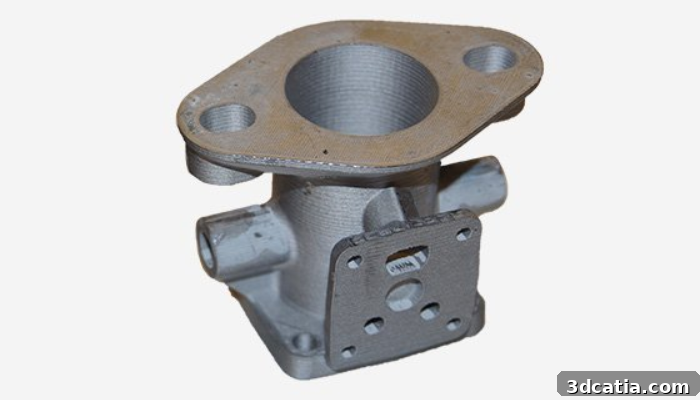
One of the most immediate safety benefits of 3D printing is its ability to simplify access to essential vehicle components, especially during repairs. For older cars or vehicles operating in remote regions, finding replacement parts can take a long time or be impossible. Additive manufacturing enables rapid, on-demand production of original-equipment parts that might otherwise be discontinued, ensuring vehicles remain in safe, operational condition. This capacity to restore or maintain safety-critical features quickly can be crucial to preventing further incidents and preserving reliability on the road.
A replica carburetor created for a vintage racecar by Tecron (photo credit: Markforged)
#2 : Faster prototyping for safer vehicle designs
Speed is a major advantage of 3D printing during design and safety development. Traditional prototyping methods can be slow, limiting the number of design iterations that engineers can test. Additive manufacturing lets teams quickly produce and evaluate multiple versions of safety-critical components—from crash structures to restraint systems. Rapid iteration leads to better-refined, thoroughly tested designs optimized for real-world performance. Ultimately, faster prototyping means safer cars reach the market sooner.
#3 : Improving accessibility for drivers and passengers
3D printing also enhances safety by enabling more inclusive, adaptable vehicle designs. Customized assistive devices such as driving aids, grip enhancements, and tailored control interfaces can be produced for individual needs. These solutions make vehicles more accessible and safer by allowing occupants to enter, exit, and operate vehicles with greater confidence and stability. By reducing physical strain and improving ergonomics, 3D-printed adaptations help lower the risk of injury for drivers and passengers with specific mobility requirements.
A steering-wheel assist knob available for download on Cults (photo credits: MIGUEPPC via Cults)
#4 : Structural safety through optimized seats
Seat frames play a major role in protecting occupants by absorbing impact energy and preserving posture during a collision. Several manufacturers, including premium brands, now produce 3D-printed seat frames. Additive manufacturing enables lightweight frames with advanced geometries that improve energy absorption and resistance to deformation. Customization to occupants’ body shapes and seating positions can further enhance safety outcomes. These high-performance, tailored components reduce the risk of severe injuries by providing consistent support and resisting collapse during an impact.
#5 : Improved airbag deployment components
Airbag systems benefit from 3D printing, particularly the housings and mountings that enable rapid, reliable deployment. For example, suppliers have used selective laser sintering (SLS) and other additive techniques to produce driver airbag housings that must withstand high loads while holding the inflator and cushion securely. Additive manufacturing allows designers to use high-performance composite materials, refine deployment mechanisms, and ultimately deliver more complete protection in the event of a crash.
3D-printed airbag housing (photo credit: Joyson Safety Systems)
#6 : 3D-printed headrests to reduce whiplash and impact forces
3D-printed headrests can use customized lattice or gyroid structures that absorb and dissipate impact energy more efficiently than traditional foam, reducing forces on the neck and head. These internal structures can be tailored to each occupant’s anatomy for better support and minimized movement. By preventing excessive head motion, such designs help lower the risk of whiplash. While further research is ongoing, preliminary studies suggest that reinforced gyroid and similar fill patterns show excellent compressive behavior, in some cases reducing injury risk by notable margins.
#7 : Enhancing safety and efficiency of electric vehicles
3D-printed battery enclosures for electric vehicles improve safety through lightweight, highly resilient structures that absorb energy in a collision and shield cells from impacts or road debris. Advanced lattice and metamaterial designs outperform some traditional materials in energy dissipation and weight reduction. Several automakers have reported significant weight savings using 3D-printed composite housings, which helps both safety and range. These designs also make it easier to integrate cooling channels and thermal protection directly into the enclosure.
#8 : Safer automotive lighting and signaling
Additive manufacturing enhances lighting safety by enabling rapid prototyping and tailored components for headlights, taillights, and signaling accessories. 3D printing lets engineers precisely test optical performance and durability, improving visibility while reducing glare under different conditions. Manufacturers use 3D-printed lenses and housings for better fit, quicker repairs, and less waste, all while maintaining the integrity of lighting systems that are essential for road safety.
3D-printed turn signals on a Mazda RX-7 (photo credit: Michael Burton)
#9 : Better rollover protection
3D printing improves rollover protection by enabling the creation of lightweight, extremely strong structures such as reinforced roof rails, pillars, and roll cages. These components can be optimized to absorb impacts and preserve cabin integrity during a rollover. Additive manufacturing allows for metal lattice nodes and other printed safety parts that increase chassis stiffness and strength without excessive weight. Early data from research groups indicate that roof pillars reinforced with lattice structures and crash boxes can redistribute and absorb impact forces during rollovers, reducing intrusion and deformation while increasing energy absorption.
#10 : Honeycomb energy absorbers and impact zones
3D-printed underbody shields and integrated impact zones protect key components—such as powertrain elements—by deforming in a controlled way during collisions or when struck by debris. Energy absorbers optimized with printed lattice and honeycomb structures effectively absorb and dissipate energy, often outperforming traditional foam or hollow parts. Designs can include crush initiators and multi-material layers to further improve impact resistance. These solutions provide lightweight, customizable protection with improved crash performance. Studies in materials engineering have shown that certain micro-lattice structures offer higher residual compressive strength and improved corrosion resistance compared with conventional materials, enhancing both energy absorption and durability.
On the right, a 3D-printed Singaporean car using honeycomb structures; on the left, a cross-section design featuring a 3D-printed honeycomb structure (photo credit: Aamer Nazir)
What do you think about using 3D printing to enhance automotive safety? Share your thoughts in the article comments. If you follow developments in additive manufacturing for transport, be sure to explore further coverage and community discussion.
Cover photo credits: Adobe Stock (left) and Tyler Clemmensen via Unsplash (right)
The post 10 Ways 3D Printing Improves Car Safety first appeared on 3dcatia.