3D-Printed Skin Patch Speeds Scalp Hair Regrowth
3D printing is being used across many areas of medicine, opening new possibilities for patient care and surgical reconstruction. A recent study from researchers at Penn State demonstrates a significant advance: they successfully bioprinted full-thickness skin that includes hair follicles, using human-derived adipose tissue, stem cells, and supportive structural components. The team applied this bioprinted skin to restore damaged scalp tissue in rats, moving closer to clinically relevant solutions for complex wounds and facial reconstruction.
Previous work has produced thin skin layers with 3D printers, but this study is the first to print a living, multilayered skin system that includes the hypodermis—the deepest skin layer made of fat and connective tissue that provides structural support. A notable achievement of the Penn State effort is that the bioprinted tissue can be applied during surgery using an intraoperative bioprinting approach. The outermost epidermis was not printed directly; instead, the researchers relied on the underlying printed dermal and hypodermal layers to induce natural epidermal regeneration, which reduces procedural complexity and encourages more physiological healing.
Photo credit: Bioactive Materials
The study was published in the journal Bioactive Materials. Ibrahim T. Ozbolat, professor of engineering science and biomedical mechanics and lead of the international research collaboration, explained the clinical motivation: “Reconstructive surgery to repair facial or cranial trauma from injury or disease is often imperfect, resulting in scarring or permanent hair loss. With this work, we demonstrate a full-thickness bioprinted skin capable of growing hair in rats. This represents a step toward more natural and aesthetically effective head and facial reconstruction for humans.”
How to reconstruct skin and hair with 3D printing
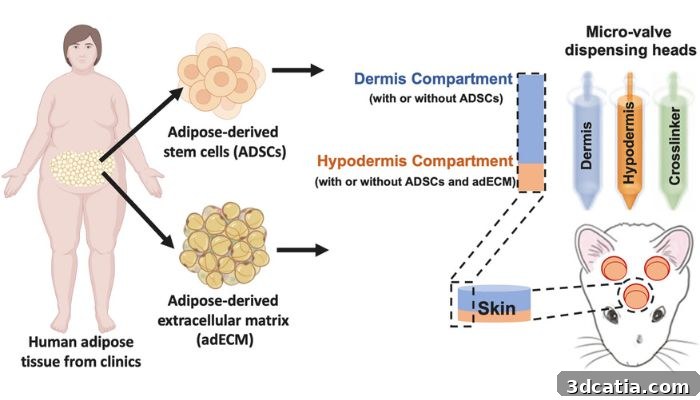
The research team used a three-cartridge 3D bioprinter, each cartridge loaded with a different bioink component. The study used adipose tissue obtained from patients at the Penn State Health Milton S. Hershey Medical Center. From that fat tissue the team isolated extracellular matrix (ECM) components, which provide structural support and mechanical stability to tissues. Portions of the bioink were formulated from this adipose-derived matrix to recreate the hypodermal environment.
For the second bioink component, the researchers extracted adipose-derived stem cells (ASCs) from the same tissue source. These stem cells are multipotent and capable of differentiating into various cell types needed for tissue regeneration. The third cartridge contained a fibrin-based coagulation solution that acts as a supportive scaffold during and after printing. By combining these three elements—ECM-rich bioink, stem cells, and fibrin—they could recreate a layered tissue that supports healing and hair follicle formation.
“The three compartments allow us to co-print the matrix-fibrinogen mixture and the stem cells with fine control. We printed directly into the wound site to form the hypodermis, which contributes to wound healing, hair follicle production, temperature regulation, and other essential functions,” says Ibrahim Ozbolat.
The hypodermis plays a central role in the conversion of stem cells into adipocytes (fat cells) and supports numerous physiological functions, including wound repair. It also influences the hair follicle cycle by creating the microenvironment necessary for follicle development and hair growth. Ozbolat and his colleagues found that supplying both a supportive matrix and stem cells together was essential for reconstructing a functional hypodermis capable of promoting hair follicle formation.
Their experiments further suggest that adipose cells can remodel the extracellular matrix to make it more conducive to hair root development. These findings indicate promising translational potential for reconstructive surgery of the face and scalp, particularly for patients with traumatic or disease-related hair and skin loss. The ability to print full-thickness skin with integrated follicular structures could lead to more natural cosmetic and functional outcomes in human patients.
For additional scientific detail, readers can consult the original study published in Bioactive Materials, which provides experimental data, methods, and discussion of translational prospects. The research highlights how advances in bioprinting technology, combined with patient-derived cells and matrix components, are bringing personalized reconstructive options closer to clinical reality.
Cover photo credit: Penn State
The post 3D-Printed Skin Patch Speeds Scalp Hair Regrowth first appeared on 3dcatia.