3D Printer Prototype Prints with Regolith
A team of Chinese scientists at the Tiandu Laboratory has announced a significant technological advance in aerospace additive manufacturing: a prototype 3D printer that can use lunar regolith as its printing material. Lunar regolith, the fine dust and broken rock that covers the Moon’s surface, is an abundant in-situ resource that could dramatically reduce the need to transport construction materials from Earth. This development marks an important step toward building infrastructure directly on the Moon and improving the long-term sustainability of lunar missions.
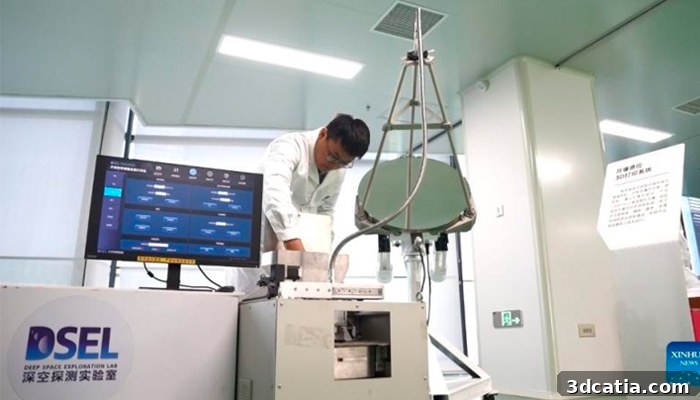
The printer prototype combines a high-precision solar concentrator with a flexible fiber-optic energy transmission network. This arrangement enables the system to reach the high temperatures required to sinter or partially melt regolith, making it compatible with additive manufacturing processes. Yang Honglun, the laboratory’s chief engineer, explains: “This new 3D printing approach uses regolith as the fabrication feedstock, leveraging local lunar resources and avoiding the need to carry additional materials from Earth.”
Photo credit: Xinhua
The 3D printer prototype
Initial trials were performed on Earth and demonstrated that regolith can be transformed into structural shapes such as lines, surfaces and three-dimensional volumes. These tests validated both the solar concentration system and the printing and molding processes. One of the primary engineering challenges was controlling and delivering concentrated solar energy robustly in the extreme thermal and vacuum conditions expected on the lunar surface. A multidisciplinary team of planetary scientists and optical engineers developed solutions to address energy management, material handling and thermal control, enabling repeatable fabrication using simulated regolith.
Technical approach and innovations
The system’s key innovation is the coupling of a precision solar concentrator with flexible fiber-optic transmission to transport concentrated sunlight to the print head. This avoids relying solely on heavy onboard power systems and instead harnesses abundant solar energy available at many lunar sites. The concentrator focuses sunlight to achieve the temperatures needed to sinter or partially melt regolith particles, which can then be deposited in layers to build structural elements. The process is designed to work with the naturally occurring particle sizes and mineralogy of lunar soil simulated in terrestrial tests, reducing the need for extensive preprocessing.
In addition to the energy-delivery architecture, the prototype incorporates motion control and deposition strategies tailored to low-gravity, dusty environments. Engineers addressed dust adhesion and abrasive wear—common concerns with lunar regolith—through material choices and protective design. While further work is required to qualify components for the full rigors of the lunar environment, the Earth-based experiments provide a strong proof of concept for in-situ resource utilization (ISRU) via additive manufacturing.
Potential applications and benefits
Using regolith for 3D printing could enable a variety of essential lunar infrastructure, including habitats, radiation and micrometeoroid shielding, landing pads, runways, storage depots and basic utility structures. Building these elements in place would significantly reduce launch mass and mission cost compared with transporting finished structures from Earth. Local fabrication also supports a more sustainable and resilient approach to lunar exploration by enabling maintenance, repair and expansion without continuous resupply.
Beyond construction, regolith-based additive manufacturing could support scientific and commercial activities by enabling custom experimental platforms, instrument housings and temporary shelters. The technology also expands the range of mission architectures that are feasible, from short-term exploration outposts to longer-term scientific bases and potential commercial installations, provided systems are adapted and qualified for lunar deployment.
Challenges and next steps
Despite promising demonstrations, several challenges remain before this type of printer can operate on the Moon. Engineers must optimize the system for low temperatures, vacuum operations, abrasive dust, and the thermal cycling experienced during lunar day-night cycles. Integration with power, robotic deployment, and autonomous operation systems will be critical for transporting and operating a printing system on the lunar surface. The next steps include extended terrestrial testing under simulated lunar conditions, qualification of materials and components, and development of deployment strategies for eventual lunar demonstration missions.
This prototype represents a practical advancement toward using local resources for additive manufacturing in space. If matured and deployed successfully, it could play a central role in enabling more ambitious and sustainable lunar exploration and development.
What do you think about a 3D printer that can build with regolith? Share your thoughts in the article comments. Interested in the latest developments in 3D printing for aerospace? Follow industry coverage and discussion on social platforms.
*Cover photo credit: NASA
The post 3D Printer Prototype Prints with Regolith first appeared on 3dcatia.