3D-Printed Titanium Reservoir: Application of the Month
A consortium of South Korean companies and research institutes has announced a major advance in space technology. The Korean Institute of Industrial Technology (KITECH), the Korea Aerospace Research Institute (KARI), KP Aero Industries, AM Solutions and Hanyang University partnered on an ambitious program to advance additive manufacturing for the aerospace sector. Their goal was to produce high‑pressure titanium tanks—critical components for launch vehicles and satellites—using additive manufacturing. The team recently reached a milestone by successfully producing and validating a fully 3D‑printed titanium tank, opening the door to further hardware innovation for space systems.
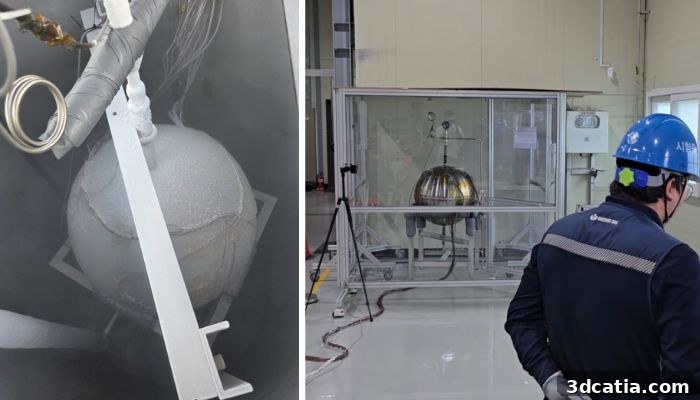
The project set out to demonstrate both feasibility and structural integrity for a 3D‑printed space tank under realistic operating conditions. The resulting cryogenic titanium tank measures 640 mm in diameter and holds 130 liters. To assess performance under extreme conditions, the tank was cooled and subjected to a cryogenic pressure test. It withstood an internal pressure of 330 bar at -196 °C while cooled with liquid nitrogen. This represents the first successful global test of a high‑pressure, 3D‑printed pressure vessel under such extreme cryogenic conditions.
Cryogenic pressure test (left) and ambient temperature pressure test (right)
DED technology applied to aerospace manufacturing
KITECH led the additive manufacturing process using directed energy deposition (DED), a method that deposits and melts titanium layer by layer. The production sequence involved printing two titanium hemispheres, which were later welded together and then subjected to heat treatment and precision machining to form a single monolithic tank. Real‑time monitoring enabled the implementation of optimized deposition paths, which was essential to reach the geometric precision and mechanical integrity required for aerospace use.
Additive manufacturing provides significant advantages over traditional production methods, especially for titanium components. Conventional approaches face limitations such as long lead times for tooling, restrictive design constraints, and high costs. By contrast, 3D printing reduces material waste, offers greater design freedom and enables cost reductions—benefits that translate directly to more efficient production of complex, high‑performance aerospace parts.
The two hemispheres were produced using DED technology and then joined to form a monolithic tank.
Why a titanium high‑pressure tank matters for spaceflight
High‑pressure tanks are fundamental components in spacecraft systems. They store liquid propellants and contain gases used for attitude and altitude control. Titanium alloys are particularly well suited to these applications because of their high strength‑to‑weight ratio and stability at low temperatures; however, they have traditionally been challenging and costly to manufacture. This project demonstrates that 3D‑printed titanium components can meet the demanding mechanical and thermal requirements expected in space operations.
Dr. Lee Hyup of KITECH KAMIC emphasized the broader implications: “This demonstration proves that large‑scale 3D‑printed structures can reliably withstand cryogenic and high‑pressure conditions that simulate real operating environments. It lays the groundwork for widespread adoption of additive manufacturing in aerospace.”
The research team
Kim Hyun‑joon from the Korea Aerospace Research Institute noted the next steps: “We will continue collaboration to perform cyclic pressure tests at typical operating pressures and to pursue additional certifications required for flight capability.” These follow‑on activities aim to verify long‑term durability under repeated loading and to advance the pathway to certified, flight‑worthy 3D‑printed hardware.
This achievement marks a significant step toward safer, more efficient and forward‑looking space systems and highlights the strong potential of additive manufacturing to industrialize the production of critical aerospace components. The successful cryogenic test underscores how DED and other metal additive processes can deliver large, structurally robust parts suitable for stringent aerospace applications.
What do you think about this 3D‑printed titanium tank? Share your perspectives in the article’s comments. If you follow developments in 3D printing for the aerospace industry, this demonstration is an important example of how additive manufacturing is maturing into a viable production route for critical space hardware.
Photo credits: KITECH
The post 3D-Printed Titanium Reservoir: Application of the Month first appeared on 3dcatia.