3D-Printed Pen App for Parkinson’s Diagnosis
Parkinson’s disease is a progressive neurodegenerative disorder that affects roughly 10 million people worldwide and is the second most common neurodegenerative condition after Alzheimer’s disease. Despite its prevalence, diagnosing Parkinson’s reliably remains a challenge. Imaging techniques such as MRI and routine blood tests can help rule out other causes or support a diagnosis, but Parkinson’s most often requires a clinical assessment: a neurologist reviews the patient’s history, symptoms and physical exam findings to determine whether the disease is present. Those clinical assessments, however, frequently lack objective quantitative markers and can vary between clinicians.
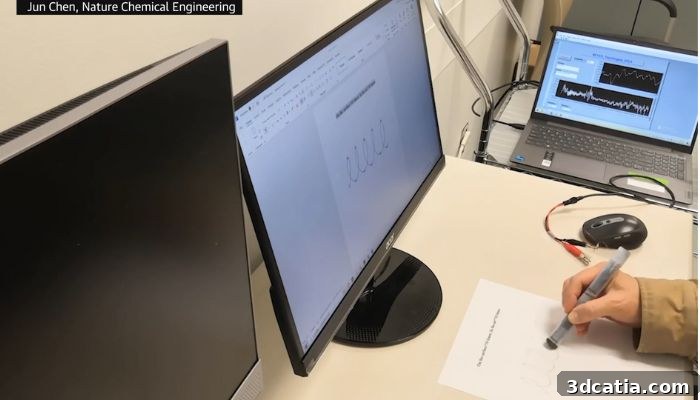
Researchers at the University of California, Los Angeles (UCLA) are developing an alternative: a diagnostic, 3D-printed pen designed to capture subtle motor abnormalities in handwriting. Handwriting is a complex task that combines cognitive processing, visual perception and fine motor control — functions commonly affected by Parkinson’s. By converting handwriting movements into measurable electronic signals, the pen aims to provide objective, quantitative biomarkers that could aid early detection and monitoring of the disease.
A patient with Parkinson’s disease writes with a 3D-printed diagnostic pen (photo credit: Jun Chen via The Guardian)
3D-printed diagnostic pen to detect Parkinson’s symptoms
UCLA’s team is not the first to use handwriting as a window into Parkinson’s. Digital tablets and motion sensors have long been applied to record pen trajectories, pressure and speed, but these systems often overlook some motor symptoms that occur during writing and may be expensive or difficult to deploy outside specialized clinics. High cost and complexity limit their scalability, especially in low-resource settings where access to neurologists and sub-specialty diagnostic tools is scarce. With those constraints in mind, the researchers set out to design a low-cost, scalable device suitable for broader clinical and non-clinical use.
Their solution is a pen that combines a magnetoelastic tip with ferrofluid ink. The pen’s design translates subtle mechanical deformations and ink motion into high-fidelity electrical signals. When the user applies pressure and moves the pen, the tip deforms and produces changes in magnetic flux through magnetoelastic coupling; the ferrofluid ink shifts during strokes, adding complementary dynamic information. Those physical changes induce voltage signals in an internal spring element. The resulting electrical traces represent the fine-grained motor patterns of handwriting, converting them into quantitative data that can be analyzed algorithmically. To keep production accessible and cost-effective, the pen’s body uses a simple geometry that can be manufactured via standard FDM 3D printing; the UCLA team printed prototypes with a Stratasys F123 Composite-Ready 3D printer.
How the pen captures Parkinson’s-related changes
During writing, a person with Parkinson’s may exhibit tremor, bradykinesia (slowness of movement), or irregular force application. These motor disruptions translate into specific anomalies in the voltage traces generated by the pen: for example, tremors can appear as small, periodic spikes superimposed on normal stroke signals. By recording and analyzing those voltage patterns, the device can reveal irregularities that are difficult to detect visually or with standard writing assessments. In short, handwriting is converted into an electrical signal that quantifies motor irregularities objectively.
To test the approach, the UCLA team conducted a small pilot study with 16 participants, three of whom had clinically diagnosed Parkinson’s disease. Participants performed a range of handwriting tasks on surfaces and in the air, including writing words, drawing spirals and tracing wavy lines to capture different movement dynamics. The collected signals were processed and classified using machine learning models trained to distinguish patterns associated with Parkinson’s pathology. One trained model discriminated Parkinson’s patients from control participants with an average accuracy of 96.22% in this pilot dataset.
Graphic representation of the 3D-printed diagnostic pen (photo credit: UCLA)
Next steps and clinical validation
While the initial results are promising, the researchers emphasize that larger and more diverse clinical trials are necessary before the pen could be used in routine care. The UCLA pilot involved a small cohort, so broader studies are required to confirm robustness across different stages of Parkinson’s disease, varied handwriting styles, and comorbid conditions. Clinicians also stress that a single handwriting-derived biomarker should not be the sole basis for diagnosis. As Chrystalina Antoniades, Associate Professor of Clinical Neurosciences at the University of Oxford, noted in commentary on the work, a device that detects handwriting abnormalities can complement clinical assessment by revealing subtle changes that might otherwise be missed, but it should be combined with other clinical biomarkers to form a comprehensive diagnostic picture.
If validated in larger studies, the magnetoelastic, ferrofluid-based pen could become an inexpensive, scalable tool to aid earlier and more objective detection of Parkinson’s disease and to monitor disease progression and response to treatment. The full UCLA study has been published in Nature, where the methodology and detailed results are described for peer review and replication.
Photo credit: 3Dnatives
What do you think about using a 3D-printed pen to detect Parkinson’s-related motor changes in handwriting? Share your thoughts and professional perspectives. If you follow medical and dental 3D printing developments, keep an eye on ongoing research that explores how low-cost, portable sensors can bring objective neurological assessment tools to a wider range of clinical and community settings.
*Cover photo credit: UCLA
The post 3D-Printed Pen App for Parkinson’s Diagnosis first appeared on 3dcatia.