Craitor’s FieldFab: 3D Printer for Extreme Environments
Last year, U.S. troops demonstrated how far additive manufacturing has come by successfully 3D printing components for drones inside a UH-60 Black Hawk helicopter while it was in flight. Despite aggressive tactical maneuvers, constant vibrations, changing temperatures and turbulence, the printer continued to operate and produced functional parts. Central to that demonstration was FieldFab, a system developed by Craitor and engineered to withstand extreme temperatures, high altitude, operational motion, and even rain or condensation. The test provided a compelling glimpse into the portability and growing reliability of 3D printing in demanding operational environments. To learn more about Craitor and the machine behind this mission, we spoke with Eric Shnell, co‑founder and CEO.
3DN: Could you introduce yourself and explain how you first discovered 3D printing?
My name is Eric Shnell, co‑founder and CEO of Craitor. I first got involved with 3D printing in the early 2010s as a hobbyist, building and modifying printers within the maker community. While earning my bachelor’s degree in mechanical engineering at the University of California, San Diego, I trained and mentored students in campus maker spaces, which deepened my understanding of how to deploy additive manufacturing reliably at scale.
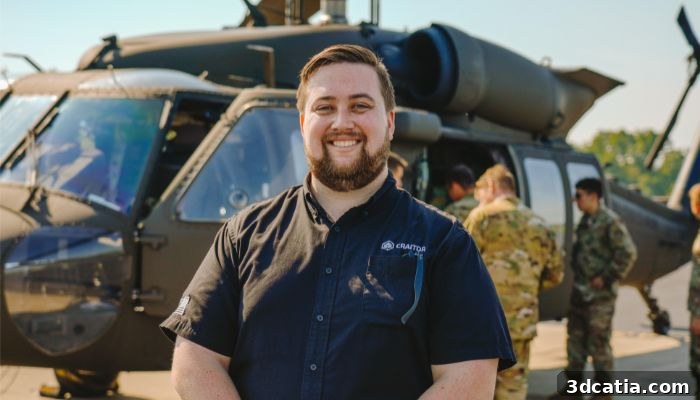
Eric Shnell
That experience led to a collaboration with the U.S. Marine Corps, where I served as a strategic technical advisor on advanced manufacturing initiatives. Those field experiences directly inspired the launch of Craitor, with a clear goal: make additive manufacturing practical and dependable in real operational settings.
3DN: What is Craitor’s mission and how did the company come about?
Craitor was born out of work with the U.S. Marine Corps, where I saw both the transformational potential of 3D printing and the practical limits that prevented it from having an immediate operational impact. Existing systems were not designed to consistently produce critical parts under extreme conditions. Craitor was founded to close that gap by delivering manufacturing capabilities that can produce mission‑critical components in the harshest environments and with limited resources—places where traditional supply chains are unreliable or non‑existent. Our vision is a true digital supply chain: certified parts produced on demand, wherever they’re needed. Simply put, our mission is to manufacture everywhere.
FieldFab is built to print in hostile environments.
3DN: What makes FieldFab suited to operate in harsh or demanding environments?
FieldFab is engineered and certified to operate in extreme conditions. It meets MIL‑STD‑810H environmental standards and can reliably print in temperatures ranging from −40 °C to 49 °C, regardless of humidity. The unit is also certified for tactical transport by air, land and sea. Beyond ruggedness, FieldFab is highly automated to minimize operator training—what typically takes days in the industry can be reduced to roughly 15 minutes—so the system behaves more like a parts vending machine than a traditional 3D printer. The result is a platform that’s easy to use, stable and dependable.
That level of reliability enables direct collaboration with OEM partners to establish a digital supply chain where certified parts can be produced on demand at the point of need.
3DN: FieldFab works with polymer‑based filaments. What kinds of applications do users print with it?
FieldFab produces functional components across a wide range of critical applications: automotive and transportation systems, communications infrastructure, medical equipment, robotics, and energy production and distribution. These are areas where supply delays can have serious or even life‑threatening consequences. By enabling local fabrication, FieldFab reduces procurement complexity and cost, and provides emergency repair capability when unexpected failures occur. In practice, it serves both as a primary source for parts and as a reliable fallback when traditional logistics fail.
FieldFab can print direct-metal substitutes, biocompatible parts, flexible components and standard items.
3DN: Can you describe a notable mission where FieldFab was used?
FieldFab has been deployed in dozens of field exercises both inside the continental U.S. (CONUS) and overseas (OCONUS), working with the U.S. Department of Defense, allied nations and commercial partners. One of the most memorable deployments was integrating FieldFab aboard a UH‑60 Black Hawk helicopter alongside Sentient Industries’ METEOR power system. During that exercise we successfully printed components for drones belonging to 2nd Order Effects while the helicopter performed combat maneuvers. Printing in flight demonstrated the system’s resilience to vibration, motion and power variation, and I was fortunate to be on board for that test.
3DN: Beyond FieldFab, do you plan to develop other products or expand the company?
Absolutely. We are building a broader ecosystem of manufacturing capabilities and digital architecture to enable true digital supply chains—from production facilities to the tailgate of a JLTV operating in a jungle. This year we plan to announce multiple layers of that ecosystem. Together they form a certified link of hardware, software and digital data that connects design authority, manufacturing and the end user within a single coordinated system.
3DN: Since founding Craitor in 2019, what challenges have you faced and how did you overcome them?
Launching a defense‑focused hardware company before defense startups were widely recognized presented real challenges. We kept the company afloat through a global pandemic, self‑funded much of our growth, and for a significant portion of that time I was a full‑time student. What made those challenges manageable was tackling them together with my team, mentors and partners. Craitor was built by people with operational experience, for people with operational needs. That clarity of mission helped us succeed where others struggled—our team understands the stakes and remains fully committed to delivering on the mission.
3DN: Any final words for our readers?
Get started and create. Additive manufacturing is moving fast—practical, portable, and increasingly reliable systems like FieldFab are helping turn digital inventory into on‑demand mission capability. We welcome feedback on Craitor and invite readers to share their thoughts in the comments below. If you follow defense‑industry 3D printing news, keep watching the space for developments in military additive manufacturing and digital supply chains.
The post Craitor’s FieldFab: 3D Printer for Extreme Environments first appeared on 3dcatia.