Scientists 3D Bioprint Kidney and Liver Tissue in Space
American company Auxilium Biotechnologies has successfully bioprinted kidney and liver tissue in space for the first time. The experiment took place aboard the International Space Station (ISS) using Auxilium’s orbital bioprinter, the AMP-1. The samples returned to Earth on June 17, landing off the coast of California after traveling on the NASA SpaceX CRS-34 mission. This milestone advances in-space biomanufacturing and moves research closer to producing biomedical products beyond our planet.
Bioprinting uses bioinks—mixtures of living cells and biomaterials—deposited layer by layer to form structures that mimic human tissue. Translating this technique to microgravity creates new opportunities to fabricate tissues and biological models directly in orbit. Producing tissues in space could yield structures with different mechanical and biological properties than those made under Earth gravity, and the approach is attracting growing interest in the regenerative medicine and tissue engineering communities.
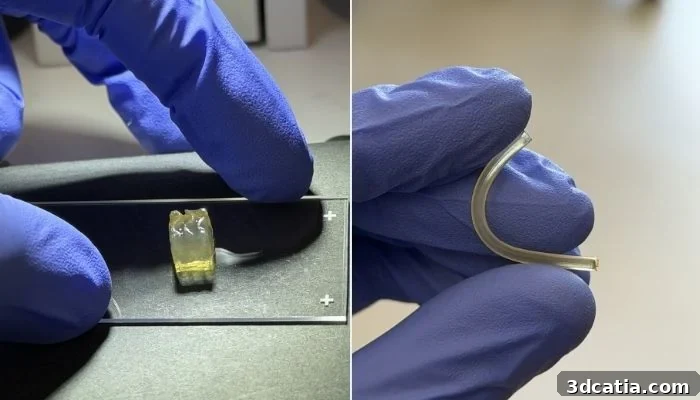
Tissue sample (left) and a nerve-repair implant, both bioprinted aboard the ISS (credits: Auxilium Biotechnologies).
Auxilium’s primary target for in-orbit bioprinting is organoids—miniaturized, three-dimensional models of human organs that replicate key functions and are used to study disease, test drugs, and predict patient responses. Organoids offer an alternative to animal testing and are typically grown on Earth then transported to orbit for studies. Being able to manufacture organoids on demand in space would remove dependence on launch schedules and terrestrial supply chains, enabling researchers to produce models as needed for experiments conducted on new orbital platforms.
During the mission, AMP-1 printed liver and kidney tissue, cartilage, and 28 implants intended for nerve repair. The flight demonstrated that a single autonomous manufacturing platform can produce both living tissues and implantable medical devices within the same mission. Wake Forest Institute for Regenerative Medicine (WFIRM) collaborated on the printing by supplying the cells and tissue models. “The successful bioprinting of living liver and kidney tissues aboard the International Space Station represents a major advance for regenerative medicine,” said Anthony Atala, professor of medicine and director of WFIRM.
Auxilium’s platform, presented as “In-Space Biomanufacturing” (credits: Auxilium Biotechnologies).
This achievement arrives amid an orbital transition: the ISS is approaching retirement and new commercial stations are in development. Auxilium is already working with commercial station developers Vast and Starlab and is exploring opportunities to extend its technology to lunar missions and long-duration exploration. Jacob Koffler, CEO of Auxilium, described the results as building on a prior demonstration of large-scale medical device manufacturing in space and as a further step toward establishing practical production capabilities for biomedical products beyond Earth.
Manufacturing tissues and implants in orbit could reshape how biomedical research is conducted in space. On-orbit production would reduce dependency on Earth-based logistics, allow more flexible experimental timelines, and potentially reveal new material behaviors in microgravity that improve tissue architecture or device performance. For researchers focused on drug discovery, disease modeling, and regenerative therapies, access to on-demand orbital biomanufacturing could accelerate development and provide novel insights unobtainable under terrestrial conditions.
The mission underscores the increasing convergence of biomanufacturing, space commercialization, and regenerative medicine. By validating that a single, autonomous system like AMP-1 can print multiple tissue types and implantable devices in the same flight, the project helps define technical requirements for future in-space manufacturing facilities. Continued collaboration between companies developing orbital habitats, academic research institutes like WFIRM, and aerospace partners will be essential to scale these capabilities and integrate them into routine scientific operations.
What are your thoughts on bioprinting in space and the potential of in-space biomanufacturing for regenerative medicine and tissue engineering? Share your perspective in the article comments.
*Cover photo: SpaceX Dragon capsule separating from the ISS on June 16, 2026, carrying mission experiments including Auxilium’s bioprinted tissues back to Earth (photo credit: NASA/Jessica Meir).
The post Scientists 3D Bioprint Kidney and Liver Tissue in Space first appeared on 3dcatia.