Startup AMFREE Overcomes Limits of Large-Scale Metal 3D Printing
As metal additive manufacturing continues to grow year after year, some challenges remain—especially when producing or repairing large-format parts. Market solutions often lack reliability, and parts produced can be non-compliant or prohibitively expensive. It is in this context that the French startup AMFREE was founded. AMFREE develops turnkey, pre-qualified hybrid XXL metal 3D printing machines designed to simplify operator work and ensure consistent, high-quality results. The company relies on artificial intelligence to correct errors and learn from potential process issues. We met with Nicolas Villedary, AMFREE’s Chief Executive Officer, to learn more about the technology, target industries, and the startup’s future plans.
3DN: Can you introduce yourself and explain your connection to additive manufacturing?
Hello, I’m Nicolas Villedary, CEO of AMFREE. We market metal 3D printers capable of producing and repairing large parts—up to five meters in size—while keeping operation simple. Our systems are delivered as a turnkey, pre-qualified package (machine, software, and related services) to guarantee the quality of results and ease of use for operators.
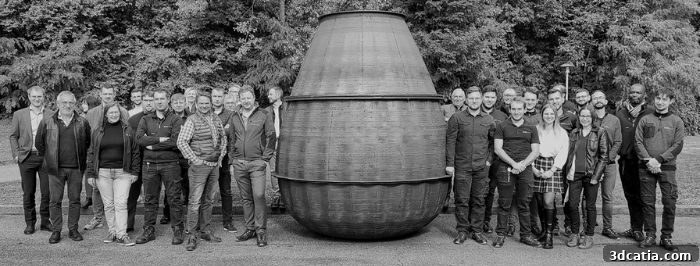
AMFREE and IREPA LASER teams beside an XXL metal part produced by 3D printing
3DN: What is AMFREE and how did the idea develop?
Founded in August 2023 and based in Illkirch-Graffenstaden in Alsace, AMFREE is a deeptech startup focused on making large-format metal additive manufacturing faster and more accessible. The core technology emerged in 2019 at the Alsatian technology resource center IREPA LASER. A pilot production line was established and is now used to qualify and produce industrial parts. AMFREE continues R&D on that same line to develop new capabilities—3D scanning, machining, process control, intelligent sensors—along with the machine-level AI and the digital service infrastructure that supports our systems.
We launched AMFREE after recognizing limits in existing additive processes related to productivity and competitiveness. Some technologies, such as powder bed fusion (PBF), provide excellent precision for complex parts but are constrained to components measuring tens of centimeters. These technologies are not suitable for true XXL parts that reach several meters in length.
Today, manufacturing very large parts often resembles artisanal work: production setups are custom or retrofitted “in-house” machines whose results vary from operator to operator and site to site. XXL parts are frequently critical, high-value components whose failure can lead to significant financial loss for users. Because these parts are hard to replace and play essential roles across industries, there was a need for standardized, simple, affordable, and economical machines capable of shortening lead times and enabling repairs—supporting circular economy goals, resource preservation, and energy efficiency.
The system uses multi-wire laser DED technology for dynamic energy management
3DN: What are the main challenges for large metal 3D printing and how does AMFREE address them?
When working with very large parts, the primary challenge is achieving right-first-time production. The size of these components makes non-conformities expensive and undermines the competitiveness of additive approaches.
AMFREE chose to provide a turnkey, pre-qualified solution so users receive all hardware, software, and validated process parameters required to manufacture XXL parts under controlled, optimized conditions. Each customer receives a machine with everything needed and benefits from 60 months of expert support in materials and processes. Our machines incorporate multiple specialized AIs that AMFREE continually enhances, which improves process consistency and reduces non-quality occurrences. We are advancing process control capabilities and developing early drift detection so the system can prevent deviations before they become defects.
AMFREE’s service center qualifies new materials and their associated AI models for industrial applications across many sectors—aviation, space, defense, general industry, rail, tooling, oil & gas, nuclear, hydraulic systems, and more—working with multiple welding wire manufacturers. This enables us to guarantee the mechanical properties of parts produced or repaired with AMFREE technology. The platform also supports development of novel materials and alloys for specialized applications by simultaneously and controllably melting multiple wires of different compositions.
Examples of parts produced by AMFREE’s 3D printing process
3DN: Can you tell us more about your machine?
AMFREE’s systems use laser-directed energy deposition (DED) with wire feeders because a laser allows precise control of energy input and the rapid, localized achievement of high energy densities. We developed an innovative solution that enables high wire deposition speeds while maintaining geometric accuracy and exceptional metallurgical quality—critical for high-value parts.
Our machines leverage artificial intelligence to predict and correct unpredictable phenomena. Smart sensors we develop monitor the process, feeding data to AI models trained on the machine’s entire dataset. These models correct deviations before they create non-conformities and eventually anticipate drifts to trigger preventive actions.
In its standard configuration, an AMFREE machine consists of a robot mounted on a linear axis carrying an AMFREE multi-wire laser head. The default build envelope is 5 x 2.5 x 2.5 meters, and systems can be adapted on request.
The standard AMFREE machine features a robot on a linear axis
Optional equipment includes a multi-axis positioner, a live spindle for cylindrical parts, and an additional robot for 3D scanning or machining, enabling true multi-process workflows. The concept is to place the component inside the machine and perform all operations around it—dimensional control, surface preparation, additive deposition, machining of areas that will be inaccessible after printing, and non-destructive inspection. This enables manufacturers to recreate parts close to final dimensions using simple spools of wire while expanding industrial service offerings to include repairs—promoting a profitable circular approach to manufacturing.
Machines are equipped with Siemens Sinumerik ONE CNCs and inherit the full feature set of machining environments. They are fully instrumented and built for Industry 4.0: connected, upgradeable, and augmented by AI.
3DN: Which sectors do you target and what are your future plans?
In Europe, we primarily target OEMs and major industrial buyers, users of forged or cast parts, and maintenance service providers.
Supported by BPI and the Grand Est region, we are accelerating digital development around the process—intelligent sensors and dynamic energy management—and building the digital and service infrastructure that will deliver future improvements from AMFREE’s service center. We are also qualifying performance of optional modules (3D scanning, machining) to simplify XXL additive manufacturing in every respect.
The machine can be optionally equipped with a 3D scanner or a machining spindle
We are finalizing a €2.5 million fundraising round to expand our team, simplify machine architecture and user experience, and intensively promote this highly productive technology across Europe. The potential of large-format wire-fed laser DED remains underappreciated by many industries.
We expect to deliver our first machine in 2024, with a goal of selling around ten units by 2026—focusing on aerospace, energy, general industry, oil & gas, and defense.
3DN: Any final words for our readers?
We are looking to form strategic partnerships with industrial players and technical centers across Europe to popularize this technology and demonstrate its still-untapped advantages. For more information, please visit our site.
*All photos: AMFREE
The post Startup AMFREE Overcomes Limits of Large-Scale Metal 3D Printing first appeared on 3dcatia.